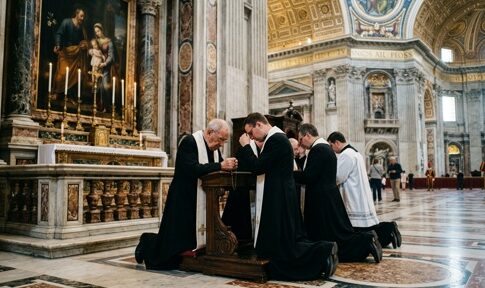
Pope Leo XIV just appointed a formerly undocumented immigrant to lead every Catholic in West Virginia, making history in a way that signals exactly where the Vatican stands on America’s immigration debate.
From Undocumented Worker to Diocesan Leader
Evelio Menjivar-Ayala’s journey reads like an improbable American story, except it culminates in Rome’s highest ecclesiastical authority placing him in charge of 24,000 square miles of territory and 1.81 million residents. The Salvadoran immigrant who once performed manual labor and learned English as a second language now holds the sole Catholic episcopal seat in West Virginia. His resume includes not just his humble beginnings but also doctoral studies at the Pontifical University of St. Thomas Aquinas in Rome and specialized formation at the Pontifical Scalabrinian Institute of Pastoral Theology for Human Mobility.
Pope Leo picks formerly undocumented immigrant to lead West Virginia Catholics, via @mboorstein https://t.co/m09pGnICO7
— Cathleen Decker (@cathleendecker) May 1, 2026
The Vatican’s Immigration Statement
Pope Leo XIV announced Menjivar-Ayala’s appointment on May 1, 2026, succeeding Bishop Mark Brennan who previously told immigrants they were not guests but full members of the Catholic Church. The timing and nature of this appointment speak volumes. By elevating a formerly undocumented immigrant to diocesan leadership, the Vatican sends an unmistakable message about who belongs in positions of authority within the American Catholic hierarchy. Menjivar-Ayala’s multilingual capabilities in English, Spanish, and Italian position him to serve diverse populations that previous bishops may have struggled to reach effectively.
A Precedent-Setting Trajectory
The new bishop’s rapid ascent through Church ranks demonstrates exceptional pastoral skill and theological formation. Ordained as a priest for the Archdiocese of Washington in May 2004, he served for nearly two decades before Cardinal Wilton Gregory ordained him as auxiliary bishop in February 2023. That auxiliary position lasted barely three years before Pope Leo XIV tapped him for diocesan leadership. His specialized studies in pastoral theology for human mobility reveal intentional preparation for ministry to migrant communities, a focus that now shapes an entire state’s Catholic direction.
The appointment reflects Pope Leo XIV’s broader strategy to reshape American Catholic leadership by prioritizing bishops with direct experience of marginalization and migration. Menjivar-Ayala’s background includes experiences most bishops never encounter: undocumented status, manual labor, language barriers, and the vulnerability that accompanies life in legal shadows. These experiences inform pastoral priorities in ways seminary education alone cannot provide. His elevation establishes a precedent that immigrant experience constitutes legitimate preparation for ecclesiastical leadership rather than disqualification from it.
West Virginia’s New Pastoral Reality
The Diocese of Wheeling-Charleston now operates under leadership uniquely equipped to address immigrant pastoral needs, even in a state not typically associated with large immigrant populations. Menjivar-Ayala inherits responsibility for Catholic communities scattered across challenging Appalachian terrain, traditionally working-class populations facing economic uncertainty, and growing Latino communities seeking pastoral care in their native language. His own working-class background and immigrant experience position him to connect with these realities in authentic ways that transcend typical episcopal remoteness from parishioner struggles.
Questions remain about how this appointment will affect immigration discourse within West Virginia’s broader political culture. The state trends conservative on immigration policy, yet its newest Catholic leader embodies the human face of undocumented immigration. His presence forces reconsideration of simplistic narratives about who immigrants are and what they contribute to American society. A formerly undocumented person now holds significant moral authority over a major religious institution, challenging assumptions about immigrant capability and worthiness for leadership positions.
The Longer View on Episcopal Diversity
Menjivar-Ayala’s appointment signals Pope Leo XIV’s commitment to diversifying American Catholic leadership beyond tokenism. The first Salvadoran bishop in United States history brings Central American perspectives to a hierarchy historically dominated by European and Irish American voices. His specialized formation in migration theology suggests future pastoral priorities will emphasize accompaniment of vulnerable populations, advocacy for immigrant rights, and challenging policies that criminalize human mobility. These priorities align with Catholic social teaching but often clash with American political preferences, particularly in conservative regions.
The Vatican’s decision to place this particular bishop in West Virginia rather than a border state or urban immigrant hub deserves scrutiny. Pope Leo XIV could have assigned Menjivar-Ayala to a diocese where his immigrant advocacy would meet less resistance. Instead, the pontiff positioned him where his message challenges prevailing political assumptions most directly. This strategic placement suggests papal willingness to confront American Catholic complacency on immigration rather than simply preaching to sympathetic audiences already convinced of immigrant dignity and rights.
Sources:
Pope Leo XIV sends former undocumented immigrant to West Virginia – The Letters from Leo