
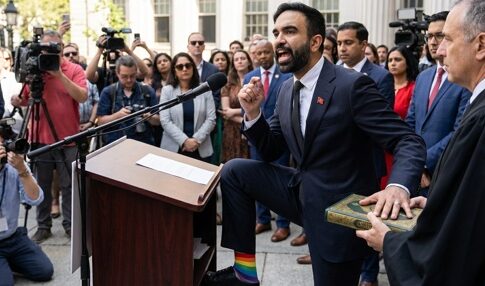
New York City’s Israel Day Parade is colliding with a mayoral decision that turns a routine attendance question into a much larger test of trust, symbolism, and public confidence.
Quick Take
- Mayor Zohran Mamdani confirmed he will not attend Sunday’s Israel Day Parade, the first New York City mayor to skip the event since 1964.[1]
- Mamdani said his decision is about attendance, not city support, and stressed that security and permits for the parade will still be provided.[1]
- He also said he wants to keep participating in Jewish communal events across New York City.[1]
- The parade’s 2026 theme, “Proud Americans, Proud Zionists,” raises the symbolic stakes of his absence.[1]
Mamdani’s stated rationale
According to reporting from the Jewish Telegraphic Agency, Mamdani said his absence should not be confused with any refusal to provide security or the necessary permits for the parade.[1] He also said, “I’ve been very clear: I believe in equal rights for all people everywhere. That principle guides me consistently.”[1] That framing places the decision inside a principle-based argument rather than a direct objection to the parade itself.
He further told reporters that he looks forward to joining and hosting “many community events celebrating Jewish life in New York and the rich Jewish history and culture of our city.”[1] That line matters because it tries to separate one highly charged public appearance from a broader relationship with Jewish New Yorkers. It also shows why the story is landing so hard: the issue is not only whether he attends, but what his absence is understood to mean in a city where public gestures carry political weight.
Why the absence is drawing such attention
The Jerusalem Post reported that Mamdani’s confirmation makes him the first New York City mayor not to participate in the parade since 1964.[1] The same report said the 2026 event’s theme is “Proud Americans, Proud Zionists,” which gives the parade an openly identity-driven character.[1] That makes the mayor’s choice easier for critics to read as a statement, even though his own remarks focus on attendance, rights, and city services rather than protest.
ABC7 New York reported that Mamdani said during the campaign he would not attend and has made his views on the Israeli government “abundantly clear.”[2] That earlier statement helps explain why the current controversy is not unfolding in a vacuum.[2] Once a mayor has signaled an intention to stay away, the decision stops looking like a scheduling matter and starts looking like a political marker, especially at an event with long-standing civic tradition.
What the reaction reveals about the wider political climate
This dispute reflects a broader pattern in which attendance at symbolic identity events becomes a proxy for loyalty, respect, or opposition.[1][2] That dynamic is especially intense when the officeholder also oversees public safety and permits, because critics can blur personal attendance with official responsibility. The result is a familiar modern problem: the public argument quickly shifts from what was actually done to what people think the decision says about motive.
New York City Mayor Zohran Mamdani confirmed he will not attend this year's Israel Day parade but said he is committed to ensuring the event is safe and secure.
At a briefing ahead of the parade, Mamdani said his administration is focused not only on keeping Jewish New Yorkers… pic.twitter.com/0hZxLWWXyw
— The Baltimore Sun (@baltimoresun) May 29, 2026
The coverage also shows how fast a narrow question can become a broader political fight. Supporters of the mayor’s explanation can point to his explicit statement that parade security and permits remain separate from his attendance.[1] Critics can point to the first absence in more than six decades and the parade’s patriotic-Zionist framing to argue that the gesture itself carries meaning.[1] In a city already split by arguments over Israel, antisemitism, and civic symbolism, both reactions are politically potent.
What stands out most is the gap between the mayor’s administrative reassurance and the public meaning assigned to his decision. The sources provided do not include a city document showing any change to permits or security planning, so the factual record here is limited to quoted statements and media reporting.[1][2] That leaves the central question unresolved in practice: whether this is remembered as a routine absence, or as a sign of a deeper break between City Hall and a major Jewish civic tradition.
Sources:
[1] Web – New York City Mayor Zohran Mamdani will not attend the city’s annual …
[2] Web – NYC Mayor Zohran Mamdani to skip Israel Parade, first absence in …
I think he is a prick. Why he was ever elected is beyond me
The warm hug of Communism