
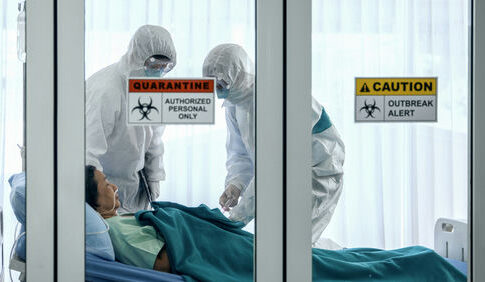
A former Centers for Disease Control and Prevention (CDC) director is warning that a new Ebola outbreak in Central Africa has all the ingredients of a public health catastrophe — and the world may already be too far behind to stop it cleanly.
At a Glance
- Former CDC Director Dr. Tom Frieden calls the current Ebola outbreak a “perfect storm” of delayed detection, limited tools, and a fragmented global response.
- The World Health Organization (WHO) estimates at least 500 suspected cases in Central Africa, with experts warning multi-country spread is a real possibility.
- Ebola is not airborne and poses low risk to the general public, but healthcare workers and communities with weak surveillance systems face serious danger.
- History shows that slow early responses — as seen in the devastating 2014–2016 West African epidemic — allow the virus to gain a head start that is extremely difficult to overcome.
A Head Start the Virus Should Never Have Had
Dr. Tom Frieden, who led the CDC during the catastrophic 2014–2016 West African Ebola epidemic, says the current outbreak in Central Africa arrived with a dangerous advantage. In a recent interview with Forbes, Frieden stated bluntly that “by the time our response has started, there are many more cases than in any prior outbreak — the virus has a big head start.” The World Health Organization estimates at least 500 suspected cases are already in play, a number that signals detection came late. [1]
Late detection is not a minor logistical problem — it is the defining challenge of Ebola containment. The virus spreads through direct contact with infected bodily fluids, which means control depends almost entirely on finding every exposed person, isolating them, and breaking every chain of transmission before the next generation of cases ignites. When hundreds of cases exist before a coordinated response begins, that task becomes exponentially harder for already-strained public health systems. [2]
Why Ebola Control Is Fragile by Design
Ebola does not spread through the air, and medical experts note the general public’s risk remains very low outside of direct contact with an infected individual. That distinction matters, but it does not make the outbreak manageable by default. Effective control requires aggressive contact tracing, safe burial practices, and strong protection for healthcare workers — all of which demand functioning infrastructure, community trust, and international coordination. When any one of those elements breaks down, the virus finds an opening. [2]
The 2014–2016 West African epidemic illustrated exactly how badly things can go when response lags behind transmission. What began as a manageable regional outbreak grew into the largest Ebola epidemic in recorded history, ultimately killing more than 11,000 people across multiple countries. The CDC’s own after-action documentation from that period reflects the same structural logic Frieden is invoking today: missing even a single transmission chain can reignite an outbreak that appeared to be fading. [3]
Multi-Country Spread and What It Means for Americans
Frieden has specifically raised the risk of multi-country spread, a threshold that transforms a regional health crisis into a global one requiring coordinated border surveillance, travel monitoring, and rapid-response deployment. Healthcare workers who have survived Ebola infections have described the disease as among the most physically and psychologically devastating experiences imaginable, underscoring the human cost borne by the people on the front lines of any response. [4]
Former CDC director Dr. Tom Frieden says Ebola is a 'perfect storm' https://t.co/TpfyaHb2a1
— USA TODAY Health (@USATODAYhealth) May 28, 2026
For Americans, the immediate personal risk is low — Ebola does not spread easily in communities with modern medical infrastructure. However, a multi-country outbreak strains the same international public health networks that serve as the early warning system for any emerging disease threat reaching U.S. shores. Frieden’s warning is less about Americans contracting Ebola tomorrow and more about whether the global architecture for catching outbreaks early is functioning — a question that carries real consequences regardless of political affiliation. The concern cuts across ideological lines: whether you believe in robust international health engagement or prioritize America-first preparedness, a virus with a head start and a fragmented response is a problem no one can afford to ignore. [1]
Sources:
[1] YouTube – Former CDC director Dr. Tom Frieden says Ebola is a ‘perfect storm’
[2] YouTube – Ebola Outbreak Risks ‘Multi-Country Spread’: Former CDC Director
[3] YouTube – Ebola Risk To Americans, Surgeon General Warning On …
[4] Web – [PDF] CDC’s Response to the West African Ebola Epidemic 2014-2015