
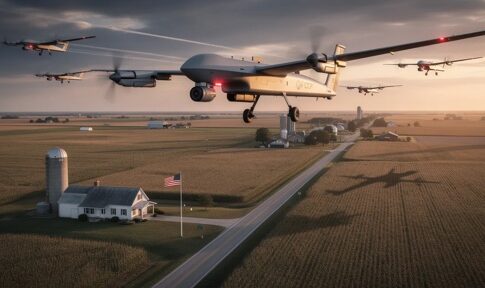
Cheap drones, artificial intelligence, and automated propaganda are changing the economics of war faster than our laws, our military bureaucracy, and our defenses at home can keep up.
Story Snapshot
- Cheap, software-driven systems are giving smaller powers new ways to threaten America’s costly ships, tanks, and bases.
- Artificial intelligence is supercharging information warfare, flooding crises with fakes that make it harder for citizens to know what is true.[1][2][3]
- Experts warn that artificial intelligence is worsening unstable “information environments,” including in nuclear standoffs.
- Big tech and defense contractors are racing ahead while governance and safeguards lag behind.[3][4]
Cheap Drones And Software Are Undercutting Old War Economics
For most of the twentieth century, military power was measured in big-ticket hardware: aircraft carriers, fighter jets, tanks, and heavy bombers. Conflicts from Ukraine to the Middle East now show that low-cost, software-enabled drones and autonomous systems can threaten or damage far more expensive platforms, changing the cost‑exchange equation on the battlefield. Analysts describe this as a shift toward scalable, distributed systems that can be produced in large numbers rather than relying solely on a few exquisite assets.[5]
As these systems spread, the traditional American advantage of high-end technology and industrial scale is being challenged by adversaries who can buy or build cheap drones, leverage commercial artificial intelligence, and coordinate attacks with online propaganda. Observers note that this creates a new kind of arms race in code and data instead of steel alone. For taxpayers, that means every billion-dollar asset must increasingly survive against swarms of tools that may cost only thousands of dollars per unit.
Information Warfare: Artificial Intelligence As A Force Multiplier For Lies
Researchers tracking recent conflicts warn that artificial intelligence is transforming information warfare by making it easier to produce convincing fake videos, audio, and images at scale.[1] A report from the Centre for Emerging Technology and Security, summarized in the MIT Sloan Management Review, concludes that artificial intelligence is amplifying the “scale, speed, and impact” of misinformation during geopolitical crises, especially when people are desperate for fast updates.[1] That means hostile powers can flood the zone with lies before truth can catch up.
Independent analysis from a British policy group finds that automated bot traffic already accounts for a majority of some online activity, and that deepfake content is surging.[2] Their report describes how artificial intelligence is being weaponized for psychological manipulation and disinformation, turning social media feeds into battlefields aimed directly at citizens’ minds.[2] A policy brief from the Center for Security and Emerging Technology adds that advances in artificial intelligence are tailor‑made to automate and scale these campaigns, reducing the cost and effort required to target voters and soldiers alike.[3]
Escalation Risks: From Confusion To Nuclear Miscalculation
Strategic analysts warn that artificial intelligence‑driven information warfare is not just about embarrassing politicians or swaying elections; it can also destabilize already dangerous military standoffs. A peer‑reviewed study on artificial intelligence and the information ecosystem concludes that artificial intelligence acts as a “threat multiplier,” worsening the impact of degraded information environments in high‑stakes crises, especially under personalist leaders who already distrust outside information. In a nuclear context, misread signals or falsified footage could push an insecure regime toward rash decisions.
Foreign policy experts also argue that Washington is still far from a consensus on how to manage these artificial intelligence security risks.[4] The Council on Foreign Relations describes a growing “crisis of control” in which advanced artificial intelligence systems are being deployed faster than lawmakers can agree on guardrails.[4] That gap between capability and governance leaves democracies exposed: adversaries and even non‑state actors can exploit cheap artificial intelligence tools while the United States debates rules, liability, and jurisdiction.[4]
Delay, Denial, And A Coming Backlash
Some technologists predict a looming public backlash once citizens realize how thoroughly artificial intelligence can be used to deceive them during wars and emergencies.[5] Commentators note that as deepfakes and synthetic media spread, people may stop believing authentic evidence—a dynamic sometimes called the “liar’s dividend”—because everything can be dismissed as artificial intelligence generated.[5][2] That collapse of trust would hurt honest whistleblowers, independent journalists, and even credible military warnings, all while benefiting regimes and extremists that thrive on confusion.[2]
Experts on information warfare are already urging more resilient fact‑checking, provenance tools, and public education to counter artificial intelligence‑driven deception.[6] A panel for International Fact‑Checking Day emphasized that artificial intelligence is changing both the speed and sophistication of false narratives, requiring new technical and civic defenses to protect the truth.[6] For a self‑governing republic that relies on informed consent of the governed, the stakes are higher than partisan point‑scoring: the integrity of the information that citizens use to judge war, peace, and national survival is now a contested battlespace.[1][3]
Sources:
[1] Web – The New Economics of War
[2] Web – How the Current Conflict Is Accelerating AI-Powered Information …
[3] Web – AI-Driven Information Warfare: Disinformation and Psychological …
[4] Web – AI and the Future of Disinformation Campaigns – CSET
[5] Web – AI Is Facing a Crisis of Control—and the Industry Knows It
[6] Web – The (possibly) coming AI backlash and information warfare