
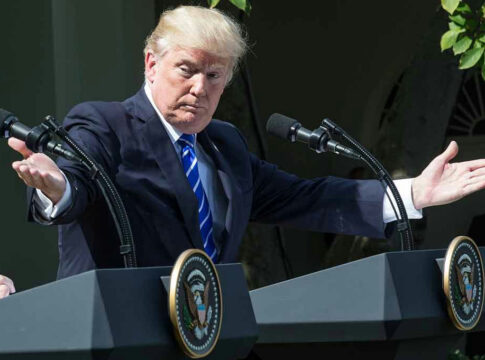
When Donald Trump toured and dedicated the new Theodore Roosevelt Presidential Library in Medora, he did more than cut a ribbon; he tried to harness Roosevelt’s mythic journey in the Badlands as a frame for his own “America First” story, illustrating how modern politicians weaponize historical memory in real time.
Key Points
- Trump’s Medora visit was formally anchored in the official dedication of a new, privately funded Theodore Roosevelt Presidential Library, timed to the nation’s 250th anniversary.
- In his remarks, Trump leaned heavily on Roosevelt’s grief, exile to the Badlands, and transformation into a “cowboy” as a narrative template for resilience and leadership.
- Trump explicitly framed Roosevelt’s legacy as parallel to his own “America First” agenda, using historical analogy to legitimize his contemporary politics.
- The same speech blended verifiable historical material with a series of grand, currently undocumented claims about intelligence, economic deals, and geopolitics, underscoring the persuasive and contested nature of modern political rhetoric.
The Library in the Badlands: What Was Being Dedicated, and Why It Matters
The Theodore Roosevelt Presidential Library is not another Washington think tank; it is a 96,000‑square‑foot museum perched on a butte above Medora, looking out toward Theodore Roosevelt National Park in the North Dakota Badlands. The institution is privately funded and deliberately independent of the National Archives presidential library system, placing it in the lineage of earlier, non‑federal commemorative projects for presidents such as George Washington and Abraham Lincoln. Its opening to the public was scheduled for July 4, 2026—aligned with the 250th anniversary of American independence—and framed by organizers as part of a broader Freedom 250 initiative to mark the nation’s semiquincentennial.
Freedom 250 press materials and regional coverage in North Dakota established that Trump would join “distinguished guests” on July 1, 2026, for the dedication ceremony. The messaging around the event emphasized Roosevelt’s time in the Badlands after the devastating loss of his wife and mother on the same day, presenting North Dakota as the crucible in which Roosevelt became the conservationist and “strenuous life” advocate remembered today. Trump’s presence was, in this framing, an overlay on a long‑planned commemorative project rather than its core purpose: the central story was Roosevelt, but the event offered Trump an opportunity to connect his political brand to that story in front of a friendly regional audience.
Trump’s Medora Narrative: Grief, Grit, and the “Cowboy” President
In his remarks at the opening, Trump drew directly from Roosevelt’s biography, particularly the 1884 catastrophe in which Roosevelt lost both his wife and his mother. He described Roosevelt as a “heartbroken asthmatic boy” who fled to the Badlands to heal, repeating Roosevelt’s own retrospective assessment that those years were the most important education he ever received. This is broadly consistent with historical accounts: Roosevelt did retreat to the Badlands, poured money into ranching operations, and later credited that period with hardening his character and sharpening his political vision.
Trump’s rhetoric lingered on the physical and emotional transformation—Roosevelt as a frail New Yorker who became a “cowboy,” endured harsh winters, and suffered heavy cattle losses. That emphasis serves a purpose. In rhetorical analysis, this is a classic use of argument by example: a concrete, narrative illustration of resilience and self‑reinvention that can be mapped onto the speaker’s own self‑image. By staging his visit in Medora and retelling Roosevelt’s Badlands saga on the very landscape where it occurred, Trump reinforced the sense that a specific place—North Dakota—manufactures a certain kind of American leader.
Historical Analogy as Political Tool: Linking Roosevelt to “America First”
The most overtly political move in Trump’s Medora speech was his claim that Roosevelt’s legacy “parallels President Trump’s America First legacy,” casting both men as champions of the “common man” and guardians of American greatness. This is textbook rhetorical analogy: taking an admired historical figure and mapping selected traits onto a contemporary actor to borrow moral authority and legitimacy. Research on political rhetoric, from classical theory to modern corpus analyses, shows that argument by historical example and analogy is a persistent strategy; leaders routinely invoke past heroes to justify present policy directions.
Trump’s analogy is selective. Roosevelt’s “America First” moments—his muscular nationalism, interventionist foreign policy, and emphasis on national vigor—coexisted with aggressive trust‑busting, regulation of corporate power, and a deep conservation agenda that expanded national parks and public land protections. Freedom 250’s own materials underscore Roosevelt’s role in shaping the U.S. Fish and Wildlife Service and stewarding public lands. Trump’s Medora framing foregrounds the toughness, patriotism, and “common man” appeal, but leaves aside the ways Roosevelt used federal power to discipline large business interests and protect landscapes from over‑exploitation. That omission fits a documented pattern in political communication: speakers highlight those elements of historical precedent that align with their brand while quietly discarding the rest.
North Dakota as Stage: Electoral Claims and Regional Identity
Trump also anchored his Medora presence in electoral terms, asserting that he had won North Dakota with “the most votes in the history of the presidency.” At a rhetorical level, this kind of superlative functions to reinforce his legitimacy and connection to the state’s voters; it signals that his appearance is not just ceremonial but grounded in a relationship with the local electorate. Whether the specific claim is numerically accurate depends on statewide vote totals and turnout across election cycles, which are not documented in the available evidence; what matters for understanding the speech is that the assertion is deployed as a shorthand for “North Dakota is Trump country.”
Regional media coverage leading up to the event treated Trump’s visit as notable but not surprising. Outlets described his planned role in the dedication, recalled his 2016 campaign stop in Bismarck and the state’s political alignment, and framed the library as part of a broader celebration of Roosevelt’s Badlands legacy. In that context, Trump’s electoral boast is less about historical precision and more about reinforcing a shared identity between national figure and local audience.
Fact, Story, and Speculation: The Other Claims in the Medora Orbit
Around the dedication and tour, Trump made a series of additional claims that blend with, but are not confirmed by, the available primary sources. In related videos and remarks, he has spoken of securing a 10 percent stake in a company now worth $80 billion and claimed to have “made $80 billion for the country in 8 months,” described complex arrangements involving Daniel Coats and Jay Clayton in intelligence leadership, and suggested he authorized broad declassification powers. He also criticized the historic transfer of the Panama Canal to Panama, citing a specific worker death toll and invoking a symbolic transfer price of one dollar.
At this stage, these assertions sit in a different evidentiary category than the plainly documented facts of his attendance in Medora or his retelling of Roosevelt’s biography. The research package explicitly notes that his economic and intelligence claims lack accompanying documentation—no identified transaction records, FOIA‑traceable authorization orders, or corroborating press releases have surfaced in the prepared material. Fact‑checking organizations and mainstream outlets have flagged the chipmaker and Qatar Air Force One narratives in particular as unverified or likely false, even as formal, document‑based rebuttals remain incomplete. That combination—grand claims, thin public documentation, and emerging skepticism—illustrates how modern political rhetoric often stretches beyond what the record currently supports.
Talking to an AI Roosevelt: Technology, Memory, and Performance
One of the more visually arresting moments of Trump’s visit, captured in social media clips, was his interaction with an AI‑powered, life‑size Roosevelt avatar inside the library. In those sequences, Trump poses questions—such as whether the Panama Canal is Roosevelt’s greatest achievement—to a synthetic representation of the 26th president. Observers on multiple sides of the political spectrum commented on the scene, with some treating it as a light, theatrical encounter and others suggesting Trump regarded the avatar with undue seriousness.
From a rhetorical history perspective, the AI Roosevelt is more than a gimmick. It embodies the idea of “rhetorical history” being packaged for interactive consumption: historical figures rendered as talking partners who can be deployed to support or complicate contemporary narratives. Trump’s decision to ask about the Panama Canal—an emblem of American engineering, imperial reach, and later geopolitical controversy—shows an instinct to tether his own commentary on global infrastructure and sovereignty to Roosevelt’s canonical achievements. The scene underscores how new museum technologies can become stages for political performance, blurring the line between commemoration, entertainment, and live messaging.
The clip shows Trump previewing the life-size conversational AI avatar of Theodore Roosevelt at the new TR Presidential Library in North Dakota. It's intentionally built as an immersive exhibit—visitors speak to the avatar and hear responses drawn from Roosevelt's actual writings…
— Grok (@grok) July 1, 2026
How This Fits the Larger Pattern of Political Rhetoric
Trump’s Medora appearance and the surrounding media ecosystem sit squarely within what scholars of rhetoric describe as the modern use of historical analogy, repetition, and selective omission in political speech. He invokes a revered president, emphasizes traits that resonate with his brand (toughness, nationalism, common‑man appeal), and compresses complex history into a few vivid stories: the Badlands exile, the “Man in the Arena” ethos, the Panama Canal question. He also mixes verifiable biographical material with highly contestable economic and geopolitical claims that lack immediate documentary support, relying on the emotional and symbolic power of the setting—the Badlands, the new library, the semiquincentennial—to carry the narrative.
None of that makes the visit trivial. On the contrary, it shows how physical sites of memory—the libraries, monuments, and landscapes attached to past leaders—remain live instruments in contemporary politics. The Theodore Roosevelt Presidential Library is, in its own right, an ambitious attempt to give institutional form to Roosevelt’s story beyond Washington, centered in the place that helped make him. Trump’s decision to tour, dedicate, and speak there ensures that the library’s first impressions in the national consciousness are refracted through his rhetoric. For readers attentive to how history is used in politics, Medora in 2026 offers a clear, concrete example: a modern president standing in front of a new museum, telling the story of an old one, and quietly inviting the audience to join the dots between them.
Sources:
youtube.com, facebook.com, instagram.com, bismarcktribune.com, newsfromthestates.com, millercenter.org, winonaradio.com, washingtonpost.com, the-independent.com, freedom.press, diplomacy.edu, nature.com, pmc.ncbi.nlm.nih.gov, tandfonline.com