
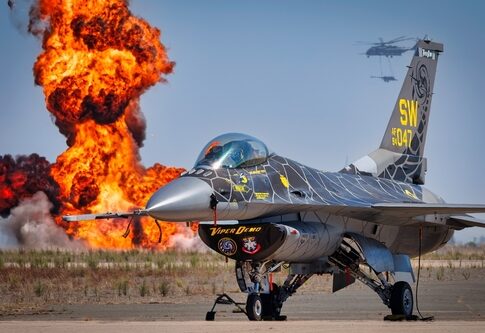
America’s elite F-35 pilots face a terrifying reality when pulling extreme combat maneuvers—they temporarily lose all memory of who they are, where they are, and what mission they’re flying.
The Mind-Erasing Effects of Extreme G-Forces
F-35 pilots pulling 9-plus G maneuvers during combat operations experience G-induced Loss of Consciousness, a physiological phenomenon that temporarily erases their identity and mission awareness. The extreme gravitational forces drain blood from the brain, causing progressive symptoms from visual “grey-out” and tunnel vision to complete blackout. Upon regaining consciousness after 15-30 seconds, pilots enter a disoriented state researchers describe as “dreaming,” where they cannot recall their name, location, or current mission. This terrifying reality underscores the physical toll our warriors endure to maintain air superiority against adversaries.
Air combat is transforming! The F-35 stops being just a shooter and starts acting like a battlefield quarterback for drones, sensors, and strikes. That kind of teaming reshapes how Marines fight and how America deters. #USMC #DefenseTech #NationalSecurity https://t.co/i0BMtbF7WU
— Robert Morton (@Robert4787) April 21, 2026
How Combat Maneuvers Trigger Cognitive Blackouts
High-performance fighters like the F-35 sustain forces up to 9 Gs during sharp turns, compared to the 2-5 Gs most people tolerate in everyday situations. During positive-G maneuvers, blood rushes from the brain toward the lower body, starving the organ of oxygen and triggering hypoxia. The “push-pull effect”—transitioning from negative-G to positive-G forces—exacerbates risks, causing retrograde amnesia that wipes recent memories. Pilots also experience involuntary muscle spasms called the “funky chicken” during recovery, further complicating their ability to regain aircraft control quickly during critical combat situations.
Training Solutions and Persistent Vulnerabilities
The U.S. Air Force relies heavily on centrifuge training to build pilot G-tolerance through anti-G straining maneuvers, teaching aviators to tense muscles and control breathing to maintain blood flow to the brain. Despite rigorous preparation, individual susceptibility varies daily based on physical condition. Fatigue, medication, alcohol aftereffects, low blood sugar, stress, and dehydration significantly reduce tolerance levels, creating unpredictable vulnerabilities during operations. Aviation experts note that Almost Loss of Consciousness (A-LOC), a milder condition, impairs cognition without complete blackout, allowing pilots to maintain some alert response capability during demanding missions.
National Security Implications for Modern Air Combat
G-LOC presents serious operational risks as the F-35’s advanced avionics systems demand full pilot cognition during high-threat scenarios. Mid-maneuver disorientation could result in catastrophic crashes or mission failures when facing adversaries in contested airspace. The phenomenon has influenced fighter jet design considerations around G-limits and prompted discussions about automation aids, including potential auto-recovery systems. As President Trump’s administration strengthens military readiness amid global tensions, understanding these physiological limitations remains critical. The substantial investment in centrifuge training and simulation technology reflects the Pentagon’s commitment to mitigating risks our pilots face defending American interests worldwide.
🇯🇵 F-35 No. 51 clips JAXA building on 3rd test, pilot fresh USAF switchpic.twitter.com/sTQoYlI9cZ https://t.co/7uyhCma3oB
— U.S.A.I. 🇺🇸 (@researchUSAI) April 20, 2026